
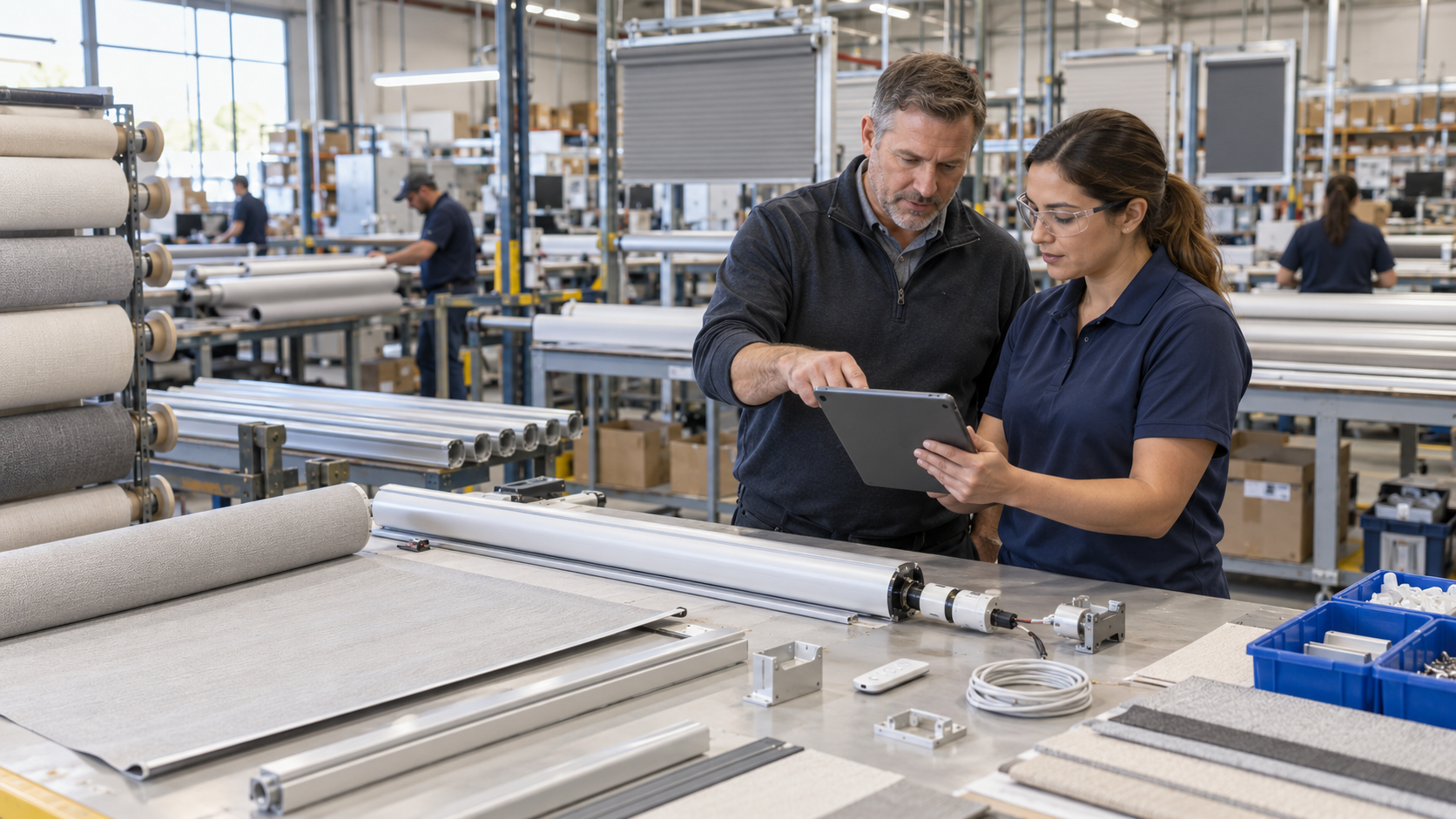
Motorized blinds and shades have traditionally occupied the premium end of the window covering market. That’s beginning to change. Easier installation, wider smart home compatibility, and growing demand for automated daylight control are making motorization practical for more residential and commercial buyers.
For window covering manufacturers, this shift represents more than an opportunity to sell higher-value products. It also adds variables to every quote and production order. Motor selection, fabric compatibility, control systems, power sources, and finished dimensions must all align before an order can move confidently into production.
Spreadsheets, disconnected quoting tools, and manual handoffs may have been manageable when automated products represented a small share of the product mix. As motorization becomes more common, manufacturers will need operating systems that can handle the added complexity without creating more administrative work.
What the Matter Protocol Means for Window Covering Volume
Matter is a smart home interoperability standard managed by the Connectivity Standards Alliance. It’s designed to make it easier for connected products from different manufacturers to work across major smart home ecosystems.
The current story isn’t that Matter was initially ratified in Q3 2026. The Alliance released Matter 1.5 in November 2025, introducing a more unified approach to connected “closures,” including window shades, drapes, and awnings. The updated standard supports different types of movement and product configurations while offering consumers more consistent control across connected environments. According to the Connectivity Standards Alliance, the update was designed to reduce development complexity while leaving room for manufacturers to differentiate their products.
By August 2026, the Alliance’s certification database included new window covering and motor-control products certified against Matter 1.5.1. That activity signals that manufacturers are moving beyond planning and bringing more interoperable products to market.
The larger market is moving in the same direction. Mordor Intelligence estimates that the global window coverings market grew from $28.96 billion in 2025 to $30.14 billion in 2026. It projects that the market will reach $37.85 billion by 2031, representing a 4.66% compound annual growth rate from 2026 through 2031.
Manual products still accounted for 74.13% of the market in 2025, but smart, IoT-enabled systems are forecast to grow at a 5.96% compound annual growth rate through 2031, outpacing the market overall. The report describes motorization as moving from luxury to mainstream as interoperability barriers decline. Read the 2026 window coverings market analysis.
How Is the Matter Protocol Changing the Window Covering Industry for Manufacturers?
Matter is reducing a longstanding obstacle to smart window covering adoption: uncertainty about whether a product will work with a customer’s preferred smart home ecosystem. As compatibility improves, more buyers can consider automated blinds and shades without committing to one proprietary platform.
For manufacturers, that could mean greater demand accompanied by more complicated orders:
- More product lines may require motorized and smart-compatible configurations.
- Dealers will expect clear information about motors, controls, power options, and compatibility.
- Quotes must account for interdependent choices without sacrificing speed or accuracy.
- Production teams need complete specifications before fabrication, assembly, and testing begin.
- Product and pricing changes must reach sales, customer service, and production without delay.
Matter may make connected shades easier for customers to use, but manufacturers still need disciplined quoting, accurate specifications, and coordinated production to build the right product.
Why Motorized Products Require More From Your Operations System
A manual shade order already includes measurements, fabric, color, mounting style, hardware, and other custom details. Motorization introduces additional decisions that can affect pricing, materials, and production.
The correct motor may depend on the size and weight of the shade. Fabric selection can influence load requirements. The order may call for a battery-powered, plug-in, or hardwired system. Controls could include a remote, wall switch, app, voice assistant, or connection to a larger building-management system. Some projects may also require hubs, gateways, sensors, or other accessories.
These aren’t isolated choices. Changing one part of the configuration can affect the validity or price of several others. When information is spread across quoting applications, price sheets, emails, and production spreadsheets, employees must manually confirm that every combination will work.
The consequences can extend well beyond an inaccurate quote. An incompatible component may stop production after materials have been allocated. A missing control specification can trigger calls between departments. An outdated price can reduce the expected margin. Discovering an error after assembly may lead to rework, expedited shipping, or a complete remake.
Effective automated window covering production management must connect the commercial and operational sides of each order. Sales needs to know what can be built and how it should be priced. Production needs a complete, approved specification. Purchasing needs visibility into component demand, while customer service needs reliable order-status information.
Motorized Quoting and Production: Before and After Integration
| Process | Disconnected or Manual Systems | Integrated ERP Environment |
| Quoting | Employees cross-reference price lists, compatibility documents, and spreadsheets. | Approved product choices, pricing, and order information follow a consistent workflow. |
| Order entry | Specifications may be entered again when a quote becomes a production order. | Order information moves forward without unnecessary duplicate entry. |
| Production planning | Teams reconcile schedules, inventory, and changes across separate systems. | Production works from a shared, current order record. |
| Order changes | Updates may not reach every department at the same time. | Changes remain visible to the teams responsible for purchasing, production, and service. |
| Customer updates | Employees contact multiple departments to determine order status. | Customer-facing teams have reliable visibility from quote through delivery. |
What an Integrated ERP Changes
The value of window covering manufacturer ERP software isn’t simply its ability to store more information. It comes from helping manufacturers turn complex custom orders into consistent, controlled workflows.
Product configurations can be standardized so employees don’t have to reconstruct compatibility rules for every quote. Capturing complete information at the beginning of the process reduces clarification calls and gives production teams greater confidence that an order is ready to build.
That consistency can also support faster quoting. Dealers and customers may compare several fabrics, motors, controls, and power options before making a decision. A manufacturer that can respond quickly and accurately is in a stronger position to win the order.
Once an order is approved, shared information helps purchasing and production work from the same specifications. Better visibility allows teams to identify shortages earlier, schedule work more effectively, and provide realistic completion dates. Customer service can also answer questions without chasing updates across multiple departments.
PIC describes its ERP approach for window covering manufacturers as an all-in-one workflow extending from quote through delivery. The intended outcomes include simpler product configuration, more informed production scheduling, and real-time business visibility. Learn more about PIC ERP™ for window covering manufacturers.
A connected system can also strengthen relationships with retail partners. When product attributes, options, and pricing remain consistent from the original quote through manufacturing, both sides spend less time correcting orders and requesting updates. PIC previously explored this relationship in its article about ERP and retail integration for window covering businesses.
Prepare Before Motorization Becomes the Default Expectation
Manufacturers don’t need to predict exactly how quickly smart products will take over to recognize where the industry is heading. Motorized and connected products are expanding, compatibility is improving, and customers have more choices than ever.
Now is the time to document configuration rules, review how product changes reach sales and production, identify manual handoffs, and measure the cost of specification errors and rework. That assessment can reveal whether the current operation is ready for a higher volume of complex orders.
Motorization should create growth, not operational drag. An integrated platform can help manufacturers quote confidently, coordinate production, and maintain order accuracy as automated product lines expand.
Ready to see how your operation could handle growing motorized demand? Request a demo of PIC ERP™ to explore how the platform supports motorized product quoting and production coordination from the initial order through delivery.